
Step one · Notice
A neighbour, a trustee, a vicar or a community councillor notices a household having a difficult month. The information is passed quietly to the chair.
This page sets out what we mean by our work, in plain English: the 1648 bequest in modern words, each beneficiary category unpacked into a real kind of household, the values that guide every grant decision, the small theory of change behind the trust, what we promise and what we cannot, and one paragraph about something we have not always got right.

The objects of the charity, as approved by the Charity Commission under its present scheme, are the relief of need, hardship or distress among:
That is the whole purpose, set down on a single page. We do not interpret it broadly. We do not interpret it narrowly. We interpret it locally.
What follows on this page is the long version of those eleven lines — the history behind them, the kinds of household we actually have in mind when we read them, and the working rules we hold ourselves to when we apply them.
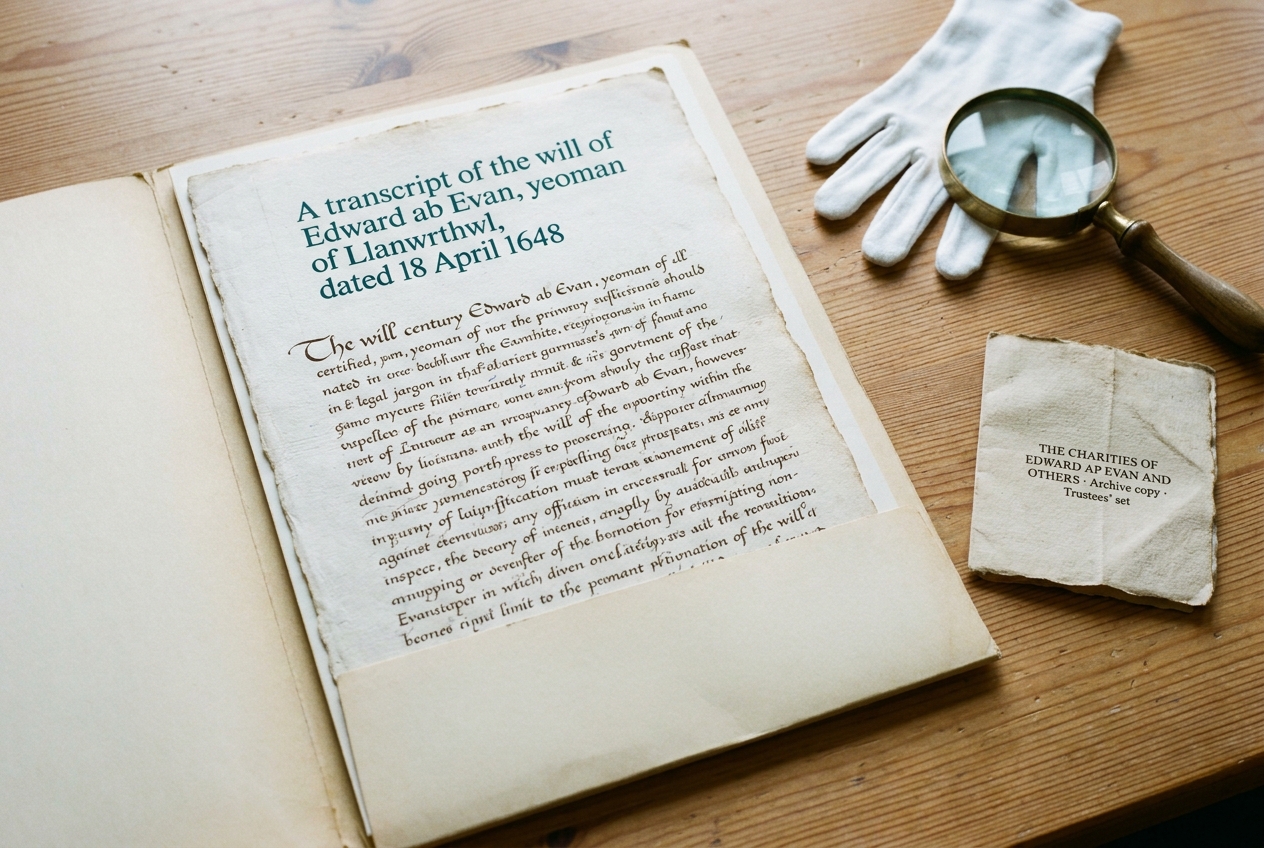
Our founding clause is fewer than thirty words long. In the original it sits inside a longer Jacobean will, between provisions for Edward ab Evan’s widow Gwenllian and a small bequest of pewter to the parish church. The line itself is plain. It directs the rent of the farm of Cae’r Llan to be applied each year ‘to the use of the poor of the parish of Llanwrthwl, whom the parish shall judge in greatest need’.
Three things in that clause have shaped four hundred years of our work.
The first is the word ‘poor’. Seventeenth-century Welsh wills used ‘poor’ in a specific sense — not as a description of character or worth, but as a description of circumstance. A poor neighbour was one who could not, that year, manage. Our trust deed today restates the old word as ‘need, hardship or distress’. The meaning is unchanged.
The second is the word ‘parish’. The bequest is for the parish, not for any wider locality. The ecclesiastical Parish of Llanwrthwl in 1648 ran from the bridge over the Wye in the south to the heads of the Claerwen and the Elan in the north — about twelve thousand acres of upland, lowland, common, bog and meadow. The geography of the bequest is the geography of the bequest. We have no power to enlarge it; only the Charity Commission can.
The third is the verb ‘judge’. The bequest does not name a list of categories or set out a means test. It places the judgement in the parish itself. The trustees do the judging. The judging is the whole of the work.
The five lines of the present trust deed are short. The kinds of household behind them are concrete. Below is what each line means in the working life of a small Welsh parish — what the trustees have in mind when we read it.
This is our oldest category. Roughly a third of the January envelopes go to a household that was widowed in the previous twelve months. The largest envelope of the year is always reserved for the most recently widowed parishioner. Bereavement is expensive in small ways that compound: a heating bill that used to be split, a car that needs an MOT, a roof tile that is now nobody’s job. We make a point of writing, not telephoning, for the first six months — the telephone, in our experience, is too sudden a thing in a quiet house.
The Rhayader catchment school sits a forty-minute walk from the bridge; the Llandrindod Wells secondary is a bus and an unreliable connection. The expenses that pinch one-parent families in our area are not the headline ones. They are school shoes, school uniforms, school trips, a packed lunch that is the same as the other children’s, and the cost of getting the car through its MOT so that the school run does not collapse. We try to anticipate the term boundaries, particularly the gap between the August bank holiday and the start of the school year.
The Cambrian uplands have higher rates of long-term respiratory and musculoskeletal conditions than the Welsh average, for reasons connected to weather, dampness, and a working population that has spent its life outdoors. A long-term illness in a small household reorganises everything: the cooking, the heating, the working hours of the well partner. Our grants here are usually small and practical: a bag of coal in February, the wood for a stove, the difference between the supermarket and the village shop on a tired afternoon.
A surprising number of our parish over the age of sixty-six live on their own — either widowed, or never married, or returned to family land after a working life elsewhere. The two crises in this category are the heating bill and the moment a small bit of the house stops working: a boiler, a roof, a kitchen window that no longer closes properly against the prevailing south-westerly. We hold a discretionary line in our small budget for exactly those moments, year-round.
This is the discretion clause. It is the most important line in the trust deed and the one that survives, in spirit, from Edward ab Evan’s original 1648 wording. It allows us to help a household that does not fit any of the named categories but is, in the judgement of the parish, in need. We use it perhaps three or four times a year — a young couple who have just lost a job, a household sandwiched between an elderly parent and a child with additional needs, a smallholder whose flock has been hit by something the insurance does not cover. The discretion is not a loophole. It is the heart of the work.
Most theories of change are diagrams a consultant draws on a wall. Ours is shorter: three blocks, three arrows, written so anyone can hold the trustees to it.
A neighbour, a trustee, a vicar or a community councillor notices a household having a difficult month. The information is passed quietly to the chair.
Two or three trustees meet, either at the next scheduled gathering or sooner if it is urgent. We agree a small grant or parcel. We never decide alone.
The chair drops the envelope round in person, or posts it in plain stationery. We do not publicise. We do not photograph. The household carries on.
A small charity is most useful when it is clear about its edges. We promise the following, plainly, to any parishioner who comes to us:
We cannot, equally plainly, promise the following:
The 1648 clause uses the comparative — ‘in greatest need’. The trustees do not, in practice, rank households. We do not, in any sitting, sort the names on the agenda into a league table. The comparative in the founding clause is, we think, a useful warning rather than a working instruction. It reminds us that the fund is small and that demand is, in any given year, greater than supply.
What it does not mean — and what we have tried not to let it mean — is that we hold back from a small need because some other household might, in a hypothetical future, have a larger one. The household in front of us is the household in front of us. The trust deed permits us to act.
Through most of the twentieth century the charity quietly excluded households who had moved into the parish in the previous two years. The rule was unwritten, but it was real. Trustees in 1972 minuted that ‘new families should look first to relatives’. We do not know how many people did not ask because of that.
The rule was set aside in the 1990s. We name it here because it is the kind of thing a small charity can do without noticing. If you are new to the parish and reading this — please write. Two years is long enough to be one of us.
A second, smaller honesty: we have, historically, been slow to help households we already help. Once a name is on our list we sometimes overlook the smaller troubles in between the larger ones. We are trying, in 2026, to ring at least twice a year rather than only at the points of acute need.
Our programmes page sets out the three small things we actually do, year after year.