
Why we still meet in the hall on a January evening.
The shape of the year for a small charity is older than any of its trustees, and it has more to do with the calendar than the bank balance.
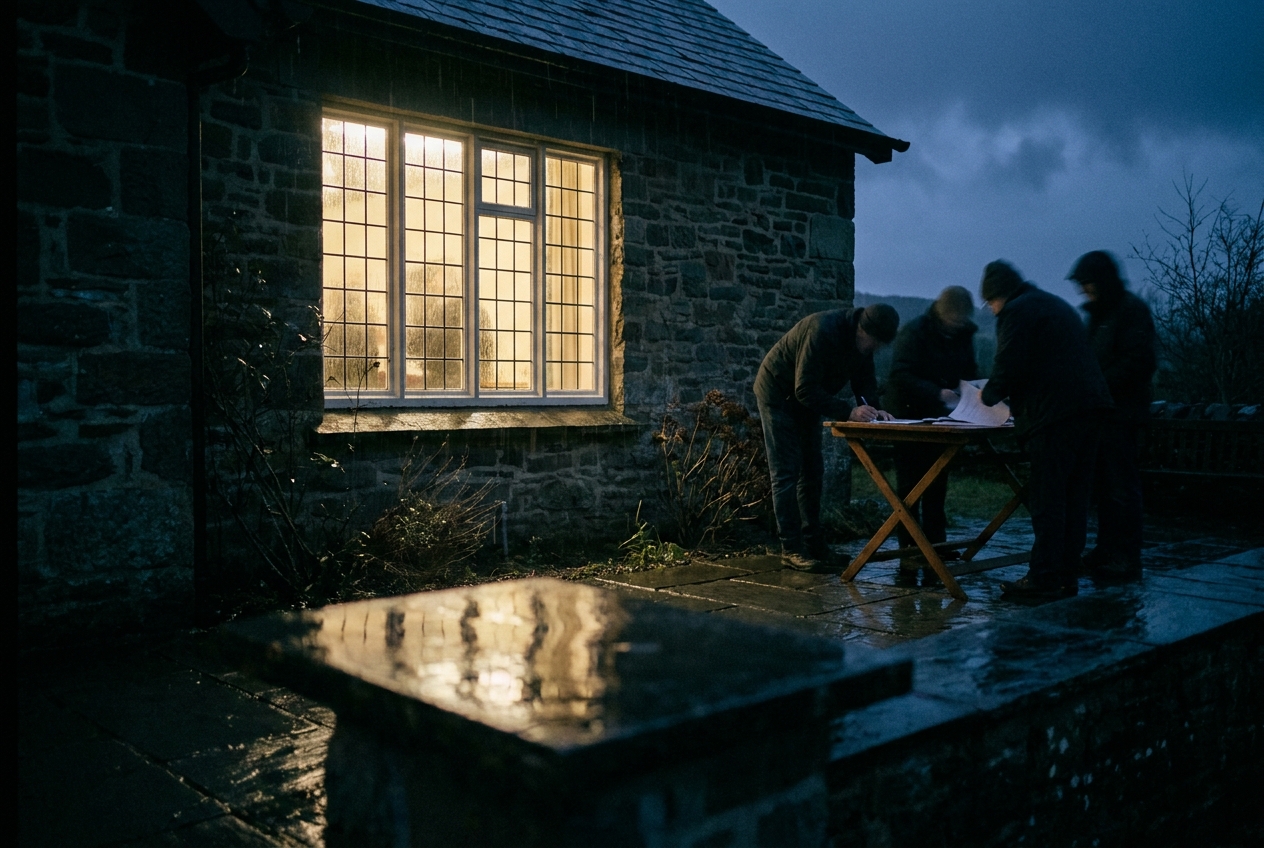
The first thing you notice when you walk into the village hall on the second Thursday of January is that it is cold. Anwen will have switched the electric heater on at five o’clock, but the building was built in 1923, and the walls are sandstone, and it takes longer than the time between the bus from Rhayader and the start of the meeting to warm up. The trustees come in fleeces. Two of them keep their coats on. Sharon brings a flask. Gareth has brought, in a small biscuit tin, four tea-cakes that his wife baked at the weekend.
People sometimes ask why we still do the distribution in January. They mean it kindly. Cold months are hard months, they say; surely the trustees would rather meet in the long evenings of April or May. The answer is that the second Thursday in January has been the trustees’ meeting since at least the 1840s, and the only person who could change it is the Charity Commission, and the Charity Commission has better things to worry about.
But there is also a more honest answer. The January distribution is a January distribution because that is when help is needed. The Christmas heating bills will have come in. The Department for Work and Pensions runs on a calendar that bears no relation to a Powys winter, and a household on a state pension can find itself in late January with no money for oil and three weeks until the next payment. By that point a forty-pound envelope is not a bonus. It is the difference between the kitchen being warm and the kitchen not being warm.
A forty-pound envelope is not a bonus. It is the difference between the kitchen being warm and the kitchen not being warm.
We meet at seven o’clock. The chair — that is to say, me — calls the meeting to order. Gareth reads the minutes from November. Sharon presents the short list of nominations. The list is short: this year there were nineteen households put forward by various neighbours, the vicar, the community councillor and two trustees. We agreed eleven envelopes. The others we will look at again in March, when the Discretionary Fund will have replenished slightly, and when one or two of those households will, with luck, no longer need us.
What surprises new trustees most is how quickly the meeting is over. We are usually finished by half past eight. There is rarely any debate; the parish is small enough that the trustees know most of the names already, and the work is in the listening that happened in the weeks before, not in the decision itself. When the decisions are made, we sign the ledger — Gareth keeps the master copy, in pencil, in a buckram book that I think pre-dates the second world war — and we put the envelopes into the post the next morning. For the eight households who live within walking distance, we deliver in person.
What the village hall actually does for us
The village hall has been the home of these meetings since 1923, when the hall opened. Before that the trustees met in the parish vestry. I have, in a folder at home, a photocopy of an 1872 minute book that records a meeting held ‘at the house of Mr Lewis, the farmer of Cae’r Llan’ — which I always read as a quiet joke about whose name was on the trust deed. We pay no rent to the hall trustees. We use a corner of the back kitchen for the four meetings, and the main room once a year for the open meeting in November. Anwen leaves the kettle full.
It matters that the meeting happens in the hall and not in someone’s front room. A small charity that meets behind closed doors is one step from becoming a closed shop. The hall is where the choir practises on Mondays and where the Brownies meet on Wednesdays and where the local member of the Senedd holds his quarterly surgery. When we are in the hall we are part of the same fabric. When the doors of the hall are unlocked, the trustees of the Caer Llan fund are not somewhere private. They are somewhere everyone in the parish knows.
A note on the cold
I said at the start that the hall was cold. It is, by the way, less cold than it used to be. We sealed the worst of the draughts in 2019. We are no longer the parish where, at the end of the January meeting in 1986, the chair’s tea froze on the way home from his car to his front door — that story is in our papers, told by his successor, with the tone of pride that small charities reserve for hard winters.
I do not think we will ever meet anywhere else. The hall in January is the work in miniature: a small group of neighbours, doing small acts of attention for other small neighbours, in a small building paid for by their grandparents’ generation, in the cold, before going home.
— RL.